Tuesday, December 19, 2006

A Mote of Dust Suspended in a Sunbeam

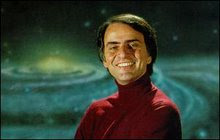
Last week I set my laptop's background to a picture of the back-side of the Voyager disk. I had just read a biography of Frank Drake, which described the process of creating the image for Pioneer and the media for Voyager. Drake said it was one of the highlights of his life. This was just a few days shy of tenth anniversary of Carl Sagan's death.


Dec 20th, 1996. I don't remember the day, but I was perhaps busy working on some DMK project. I think I wasn't long at DMK; I recall my date of hire because I was nervous to tell my new boss I couldn't start when she wanted me to because I was going to spend the weekend in the desert. Carl Sagan's passing probably got washed up in the new job, and the coming Winter Solstice family gathering.

But I believe my first contact with Sagan was stumbling upon a book in my parent's library-- Cosmos. Of all the amazing things in that wonderful book, I remember most of all two chapters. The Drake equation and Nuclear Winter. An imminent danger of ending all known life. A hope of finding intelligent extra-terrestrial civilizations. Thinking back on those days makes the threats of today, and our hopes, seem trivial.

Sagan died too soon; he still had much work left to do.

Tomorrow marks the 10th anniversary of the death of a hero. Let us remember him, and do our part to fan the sparks he ignited.

Thank you, Carl Sagan. May your memory deliver us from our demon-haunted world.

(Part of the memorial group-blog and Nick Sagan's appeal)

Thursday, December 14, 2006

Lemmings 2006

http://www.armadillorun.com/

Really awesome little lemmingsesque game.

Tuesday, December 12, 2006

Now this is high-fucking-tech...

Duct tape and bailing wire pretty much literally, so endoscopic tools with embedded six degree-of-freedom sensors (Ascension Tech). The magnetic tracking isn't without some headaches, but so far I'm pretty impressed with the precision. As expected metal screws with them, but a bit unexpectedly, the accuracy varies dramatically depending on where in the magnetic field volume the sensor is-- get too close to the emitter and all is lost.

Ah, a puppy in the window...

Or, else a giant rat. Or a small mouse in box with a strong backlight. LA: where there's a store for just about everything. Posted by Picasa

Only in SoCal...


...do you see a significant proportion of the population standing on their skateboards at political rallies. Posted by Picasa

Clinton Speaks

Clinton spoke in the UCLA sculpture garden for a whole twenty minutes or so to support Prop. 87 (it's a bit old now). Although I'm pretty pro-Clinton, and quite in-favor of taxing the hell out of corporate oil, I his speech didn't exactly incite me toward drastic actions. Still, it was cool to see him in person, if only from a mile away. Posted by Picasa

Never Never Land

Staring at those posters we used to laugh at:
Never Never Land, palm trees by the sea... Posted by Picasa

From UCLA's Botanical Gardens

Posted by Picasa

Alright, who's idea was it to use a signed short?

Posted by Picasa

Tuesday, December 5, 2006

Sexy Brains

Why do humans have such a need to express themselves? Rodents rarely are seen composing screenplays, but Sunday afternoons at the Santa Monica coffee shop shows a non-trivial portion of the population that feels this inexplicable need to communicate. Seeing all the buddying screenwriters, the throngs of novel-writers, the amateur artists and photographers. Plus the myspacers, bloggers, and chatters. Why are humans so driven to express themselves, even when no one is listening?

Geoffrey Miller, a research fellow at UCL, argues that the human capacity for expression is the result of runaway sexual selection. He proposes that the key mystery in human evolution is why humans encephalized. In the long-run, our brains were obviously useful, but big brains are an incredibly expensive adaptation. Our brains eat up about a fourth of all the energy we use. They require an exceedingly long maturation time. Large-headed infants complicate birthing.

And a key aspect to the mystery-- why only humans? Countless animals seem that they might have encephalized-- ie, lived in similar climates, with similar diets, and faced similar problems-- why just humans?

Miller's argue goes that encephalization, up until tool-use, societies and the Internet, wasn't a useful adaption per se. Rather, just like peacocks choosing mates by size of their plumage, human females selected mates that were big-brained. That metabolically expensive investment was costly, but worth it for the male. And the cost in energy showed prospective females that the male was capable enough to feed that giant brain-- and so likely to have good genetic material. Female humans like mates that can express themselves in some manner. (How many online personal ads look for a mate that can "make me laugh"?)

This makes a prediction-- since females still bear more of the cost of child-rearing, and so should they be more selective of mate. Therefore, the sexual selection should happen predominately in the males of the species. Why then do female humans also pay the developmental and metabolic price of large brains?

One answer may be that along with encephalization came an increase in male parenting requirements, evening out both the per-parent investment in offspring and the degree of sexual dimorphism. I'm not quite satisfied with this explanation though, esp because sexual dimorphism remains prevalent in other features, such as body size.

Still, I think it's a wonderfully interesting idea. And Miller's work reminds us that while natural selection is what gets Darwin most of the kudos, Darwin's brilliant analysis of sexual selection was much more subtle and really the more impressive insight.

Edge Interview with Miller

The Mating Mind

Saturday, December 2, 2006

Python/C++ using SWIG (MSVS7.1)

Petros and I got a "hello world" class exposed to Python as a DLL/module using SWIG. We ran into a few problems along the way. Nothing big, but some hang-ups that surely everybody must run into, so I thought I'd share the war story.

First, to get "natural" python syntax for your exposed C++ objects, you'll need to use Shadowing. This is a SWIG command-line option that creates a Python script file that wraps the C++ DLL containing your exposed class. Since the Python interpreter will import either DLL's or scripts, you need a new name for your C++ DLL, such as _moduleName.dll. The your shadow script is just moduleName.py. Note that the shadow script is named with lower-case letters, ignoring the case specified in the .i file.

When a Python module is loaded, it calls initModulename(). SWIG generates, instead, an initialization function called init_Modulename(). Creating a trivial initDance() that calls init_Dance()worked fine.

Finally, the standard Python binary distribution for Win32 doesn't include the debug versions of the libs. This is a problem because it is apparently using #pragma link to reference the appropriate libs-- so debug builds fail. One hack is to specify the option /U "_DEBUG" (for Visual Studio) on just the SWIG-generated C++ file (dance_wrap.cxx for the DANCE module).

And back again...

Back to the Blog. Unfortunately, I'm not much of a sysadmin and my sporadically maintained MediaWiki site was over-whelmed by spammers. It's a bit sad. I remember reading some RMS manifesto around `91 or `92 and seriously contemplating a world without passwords. What's pathetic is that it's not hackers or maliciousness that's defeated me, just mindless commercialism.